19. Dependence and Mixed Models
When Observations Are Not Independent

- why non-independence creates misleadingly confident analyses;
- how grouped and nested sampling structures arise in ecology;
- the difference between fixed and random effects;
- how to fit and interpret a simple random-intercept mixed model in R;
- how to report a mixed model in the same journal style used elsewhere in the course.
- None
Most of the models in the earlier chapters assume that each observation contributes genuinely new information. In ecological sampling that is often false, because measurements taken from the same site, transect, colony, quadrat, or individual tend to resemble one another more than measurements taken from different sampling units.
That is what dependence means in practice. So, the observations are not fully independent because they share context, history, or structure.
If we ignore that structure, the analysis becomes overconfident. Standard errors shrink, degrees of freedom are effectively exaggerated, and the model can start reporting strong-looking results that are partly artefacts of the sampling design.
Mixed-effects models provide one of the main solutions to this challenge. They allow us to keep the fixed effects that address the biological question while accounting for variation among grouped sampling units through random effects.
1 Key Concepts
- Dependence means observations are not fully independent of one another.
- Grouped structure arises when observations are clustered within sites, years, individuals, or other units.
- Fixed effects represent systematic effects of direct biological interest.
- Random effects represent structured variation among sampling units.
- A random intercept model allows each site or group to have its own baseline level.
- Mixed models are tailored to a specific sampling structure or design.
2 When This Method Is Appropriate
You should start thinking about mixed models when:
- observations are nested within sites, transects, plots, years, or individuals;
- the same unit is measured repeatedly;
- the sampling design clearly has hierarchical structure;
- treating all observations as independent would create pseudoreplication.
Typical cases include:
- quadrats within sites;
- birds sampled within beaches;
- repeated measurements on the same animals;
- monthly observations within monitoring stations.
3 Nature of the Data and Assumptions
Mixed models do not remove the need for ordinary model checking. So, for a Gaussian linear mixed model, the main assumptions are still:
- independence between higher-level units such as sites or individuals;
- approximately normal residuals;
- reasonably constant residual variance;
- a sensible specification of the random-effects structure.
The important difference is that we now no longer assume independence among observations inside the same group.
4 The Core Equations
A simple random-intercept mixed model can be written as:
\[Y_{ij} = \alpha + \beta_{1}X_{1ij} + \cdots + \beta_{p}X_{pij} + b_{j} + \epsilon_{ij} \tag{1}\]
In Equation 1, \(Y_{ij}\) is the response for observation \(i\) in group \(j\), the \(\beta\) terms are the fixed effects, \(b_{j}\) is the random intercept for group \(j\), and \(\epsilon_{ij}\) is the residual error.
The important idea is that the model has two sources of variation:
- between-group variation, captured by the random effect \(b_j\);
- within-group variation, captured by the residual term \(\epsilon_{ij}\).
Mixed models help with dependence because the they explicitly allow observations from the same site or individual to share a common baseline.
5 R Functions
The most common functions are:
-
lmer()from lme4 for Gaussian linear mixed models; -
glmer()from lme4 for generalised mixed models; -
nlme::lme()when more explicit correlation structures are needed.
A simple random-intercept model looks like this:
The term (1 | group) means that each group has its own intercept.
6 Example 1: Shorebird Landing Distance with Site-Level Dependence
6.1 Example Dataset
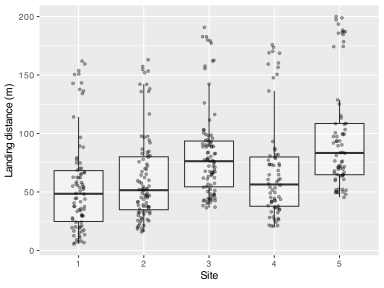
We use the BeachBirds.csv dataset from the course data folder. These data contain flight-initiation distances and landing distances for several shorebird species sampled across multiple beach sites. The important point emerging from this example is that observations collected at the same site are likely to be more similar to one another than observations collected at different sites.
Here we model land.dist as a function of bird Species and Sex, while allowing each Site to have its own baseline intercept.
| Site | Species | Sex | flush.dist | land.dist |
|---|---|---|---|---|
| 1 | Oystercatcher | Female | 12.8 | 150.9 |
| 1 | Oystercatcher | Male | 4.4 | 114.1 |
| 1 | Oystercatcher | Female | 9.5 | 153.7 |
| 1 | Oystercatcher | Female | 12.2 | 137.7 |
| 1 | Oystercatcher | Female | 10.1 | 143.3 |
| 1 | Oystercatcher | Male | 6.6 | 142.8 |
| 1 | Oystercatcher | Male | 15.4 | 134.1 |
| 1 | Oystercatcher | Male | 11.3 | 159.5 |
| 1 | Oystercatcher | Male | 13.8 | 150.4 |
| 1 | Oystercatcher | Female | 12.9 | 161.9 |
6.2 Do an Exploratory Data Analysis (EDA)
# A tibble: 1 × 5
      n n_sites n_species mean_land sd_land
  <int>   <int>     <int>     <dbl>   <dbl>
1   399       5         4      73.1    44.2
Code
Code
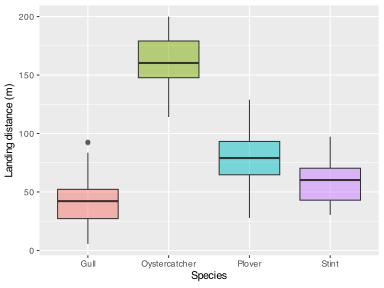
The EDA in Figure 1 and Figure 2 already shows why an ordinary model may be too simple. Landing distance differs among species, but there is also clear site-to-site variability. That suggests a grouped structure in which site should not be ignored.
6.3 State the Model Question and Hypotheses
The main biological question is whether landing distance differs among species after accounting for the fact that birds were sampled within sites.
For the primary fixed effect, the hypothesis pair is:
\[H_{0}: \text{landing distance does not differ among species once site-level grouping is accounted for}\] \[H_{a}: \text{landing distance differs among species after accounting for site-level grouping}\]
The random effect is not interpreted through a simple null-hypothesis pair in the same way. Its role is to account for the grouped sampling structure.
6.4 Fit the Model
We first fit an ordinary linear model that ignores site, and then a mixed model with a random intercept for Site.
Call:
lm(formula = land.dist ~ Species + Sex, data = birds)

Residuals:
    Min      1Q  Median      3Q     Max
-51.779 -14.413   0.021  12.883  51.754

Coefficients:
                     Estimate Std. Error t value Pr(>|t|)
(Intercept)            42.637      1.852  23.028  < 2e-16 ***
SpeciesOystercatcher  120.509      2.938  41.014  < 2e-16 ***
SpeciesPlover          36.942      2.232  16.554  < 2e-16 ***
SpeciesStint           17.228      3.355   5.135 4.45e-07 ***
SexMale                -1.591      1.933  -0.823    0.411
---
Signif. codes:  0 '***' 0.001 '**' 0.01 '*' 0.05 '.' 0.1 ' ' 1

Residual standard error: 19.15 on 394 degrees of freedom
Multiple R-squared:  0.8139,    Adjusted R-squared:  0.812
F-statistic: 430.8 on 4 and 394 DF, p-value: < 2.2e-16Linear mixed model fit by REML. t-tests use Satterthwaite's method [
lmerModLmerTest]
Formula: land.dist ~ Species + Sex + (1 | Site)
Data: birds
REML criterion at convergence: 3178.2
Scaled residuals:
Min 1Q Median 3Q Max
-2.9082 -0.7167 -0.0061 0.6730 3.2716
Random effects:
Groups Name Variance Std.Dev.
Site (Intercept) 256.0 16.00
Residual 167.9 12.96
Number of obs: 399, groups: Site, 5
Fixed effects:
Estimate Std. Error df t value Pr(>|t|)
(Intercept) 43.061 7.265 4.177 5.927 0.00354 **
SpeciesOystercatcher 119.638 1.991 390.017 60.089 < 2e-16 ***
SpeciesPlover 37.689 1.515 390.044 24.870 < 2e-16 ***
SpeciesStint 18.858 2.275 390.024 8.290 1.85e-15 ***
SexMale -2.260 1.311 390.029 -1.724 0.08550 .
---
Signif. codes: 0 '***' 0.001 '**' 0.01 '*' 0.05 '.' 0.1 ' ' 1
Correlation of Fixed Effects:
(Intr) SpcsOy SpcsPl SpcsSt
SpcsOystrct -0.074
SpeciesPlvr -0.100 0.334
SpeciesStnt -0.072 0.228 0.300
SexMale -0.104 0.045 0.085 0.106# A tibble: 2 × 2
model AIC
<chr> <dbl>
1 ordinary linear model 3495.
2 mixed model 3192.[1] 0.6039986.5 Test Assumptions / Check Diagnostics
Code
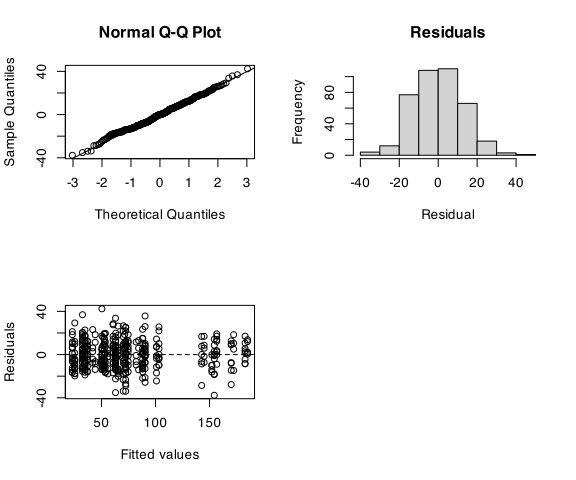
In a first-pass mixed-model workflow, the diagnostics in Figure 3 help answer the main questions:
- are the residuals grossly non-normal or strongly patterned;
- does the random effect explain a meaningful share of the variance;
- does the mixed model fit better than the independence-assuming alternative.
Here the random site effect is not trivial. The intra-class correlation is about 0.6, which means that roughly 60% of the variance represented by the model’s variance components is at the site level rather than purely within sites.
6.6 Interpret the Results
The mixed model fit is clearly better than the ordinary model by AIC, which already suggests that site-level dependence matters.
The species effects are also large. Relative to the reference species, landing distance is substantially greater for Oystercatchers and Plovers, with Stints intermediate. The sex effect is much weaker and does not provide strong evidence for a difference at the conventional 0.05 level.
The ecological finding is that species differ, and those differences should be interpreted after accounting for site-level dependence, not before. If site is ignored, the analysis behaves as though all birds were sampled independently from one large homogeneous pool.
6.7 Reporting
Methods
Landing distance was analysed for shorebirds sampled across multiple beach sites using a linear mixed-effects model. Species and sex were included as fixed effects, and site was included as a random intercept to account for the grouped sampling structure. An ordinary linear model that ignored site was fitted for comparison.
Results
The mixed model fit the data better than the ordinary linear model (AIC 3495.2 vs 3192.2), indicating that site-level dependence was important. The estimated site-level variance was substantial, with an intra-class correlation of approximately 0.6. After accounting for this grouped structure, landing distance remained much greater in Oystercatchers (\(\beta = 119.64\), \(p < 0.001\)), Plovers (\(\beta = 37.69\), \(p < 0.001\)), and Stints (\(\beta = 18.86\), \(p < 0.001\)) than in the reference species. The sex effect was weaker and not clearly different from zero (\(p > 0.05\)).
Discussion
Species differed in landing distance, but those differences were estimated while accounting for the non-independence of observations within sites. This makes the inference more defensible and avoids treating site-level similarity as if it were independent replication.
7 Example 2: Repeated Snake Habituation Within Individuals
The snake habituation dataset used earlier in the module is a better fit for this chapter than for the core ANOVA chapter. Each snake was measured repeatedly across days, so the observations are not independent. Treating snake as just another fixed factor in an additive ANOVA misses the main design point: repeated measurements on the same individuals create within-snake dependence.
# A tibble: 4 × 3
  day   mean_openings sd_openings
  <fct>         <dbl>       <dbl>
1 1              63.3        30.5
2 2              47          12.2
3 3              34.5        26.0
4 4              25.3        18.1
7.1 Why This Is a Dependence Problem
The biological question is whether the number of box openings required for habituation changes across repeated days. But each snake contributes several observations, one on each day. That means the data have a grouped structure: measurements from the same snake are likely to be more similar to one another than measurements from different snakes.
That grouped structure suggests a random-intercept model with snake identity as the grouping factor.
7.2 Fit a Naive Model and a Mixed Model
Call:
lm(formula = openings ~ day, data = snakes)

Residuals:
    Min      1Q  Median      3Q     Max
-41.333 -13.833  -3.333  11.500  43.667

Coefficients:
            Estimate Std. Error t value Pr(>|t|)
(Intercept)   63.333      9.304   6.807 1.28e-06 ***
day2         -16.333     13.158  -1.241   0.2289
day3         -28.833     13.158  -2.191   0.0404 *
day4         -38.000     13.158  -2.888   0.0091 **
---
Signif. codes:  0 '***' 0.001 '**' 0.01 '*' 0.05 '.' 0.1 ' ' 1

Residual standard error: 22.79 on 20 degrees of freedom
Multiple R-squared:  0.3195,    Adjusted R-squared:  0.2174
F-statistic: 3.13 on 3 and 20 DF, p-value: 0.04852Linear mixed model fit by REML. t-tests use Satterthwaite's method [
lmerModLmerTest]
Formula: openings ~ day + (1 | snake)
Data: snakes
REML criterion at convergence: 188.9
Scaled residuals:
Min 1Q Median 3Q Max
-1.8167 -0.6088 -0.1673 0.4153 1.9075
Random effects:
Groups Name Variance Std.Dev.
snake (Intercept) 29.68 5.448
Residual 489.73 22.130
Number of obs: 24, groups: snake, 6
Fixed effects:
Estimate Std. Error df t value Pr(>|t|)
(Intercept) 63.333 9.304 19.806 6.807 1.35e-06 ***
day2 -16.333 12.777 15.000 -1.278 0.22055
day3 -28.833 12.777 15.000 -2.257 0.03938 *
day4 -38.000 12.777 15.000 -2.974 0.00946 **
---
Signif. codes: 0 '***' 0.001 '**' 0.01 '*' 0.05 '.' 0.1 ' ' 1
Correlation of Fixed Effects:
(Intr) day2 day3
day2 -0.687
day3 -0.687 0.500
day4 -0.687 0.500 0.500# A tibble: 2 × 2
model AIC
<chr> <dbl>
1 ordinary linear model 224.
2 mixed model 201.The ordinary model behaves as though all snake-day observations are independent. The mixed model recognises that each snake has its own baseline tendency to habituate faster or more slowly.
7.3 Interpret the Results
The day effect remains the main biological signal: the number of openings required for habituation decreases across repeated days. But the mixed model estimates that change while accounting for repeated observations within snakes.
That is the crucial design lesson. This is not mainly a “two-way ANOVA without replication” problem. It is a repeated-measures problem in which snake identity induces dependence.
7.4 Reporting
Methods
The number of box openings required for rattlesnakes to habituate was analysed as a repeated-measures problem. Day was included as a fixed effect, and snake identity was included as a random intercept to account for repeated observations on the same individuals.
Results
The number of box openings required for habituation declined across repeated days, indicating that snakes habituated more rapidly with repeated exposure to the apparatus. Modelling snake identity as a random effect accounted for the non-independence created by repeated measurements on the same individuals, making the day effect interpretable at the correct design level.
Discussion
The important point is not only that habituation changed through time, but that the analysis respected the repeated-measures structure of the experiment. This is why the example belongs with dependence and mixed models rather than as a core factorial ANOVA illustration.
8 What to Do When Assumptions Fail / Alternatives
- If the response is not Gaussian, move to a generalised mixed model with
glmer(). - If repeated measurements through time create autocorrelation, consider a model with explicit correlation structure rather than relying only on a random intercept.
- If the random-effects structure is biologically richer than a simple intercept, extend it cautiously to random slopes where the design supports that.
- If the design is fundamentally pseudoreplicated, a mixed model cannot rescue the study completely; it can only model the dependence that is actually observed.
9 Summary
- Mixed models are needed when observations are grouped or otherwise dependent.
- The random effect is not an afterthought; it represents the sampling structure directly.
- In the beach-bird example, site-level dependence was strong enough to improve model fit markedly.
- Species differences in landing distance remained important even after that dependence was accounted for.
Reuse
Citation
@online{smit2026,
  author = {Smit, A. J.},
  title = {19. {Dependence} and {Mixed} {Models}},
  date = {2026-04-07},
  url = {https://tangledbank.netlify.app/BCB744/basic_stats/19-dependence-and-mixed-models.html},
  langid = {en}
}