Introductory Lecture
1 Basic House Keeping
So before we start with this module, let me give you some background on how I’d like to proceed.
Lectures will be held on Mondays, early Tuesdays, and early Thursdays. Fridays have an allocated practical time slot, which we may use if necessary. However, my intention is to use that slot mainly for question and answer sessions, but you’ll have to plan ahead and schedule my presence during this time.
On Mondays, Tuesdays, and Thursdays, we’ll have in-person lectures in the class. All of the lecture material that I’ll be presenting in the class will be based on the content of various lecture slides, which I’ll be displaying as I talk.
In total, you have available to you in-person lectures (in class, obviously), pre-recorded lectures (accessible from iKamva) that correspond more or less to what I’m saying in class, and textual transcripts (here on The Tangled Bank) of all of the material. All of this is available to you and should help you understand the content of BDC223.
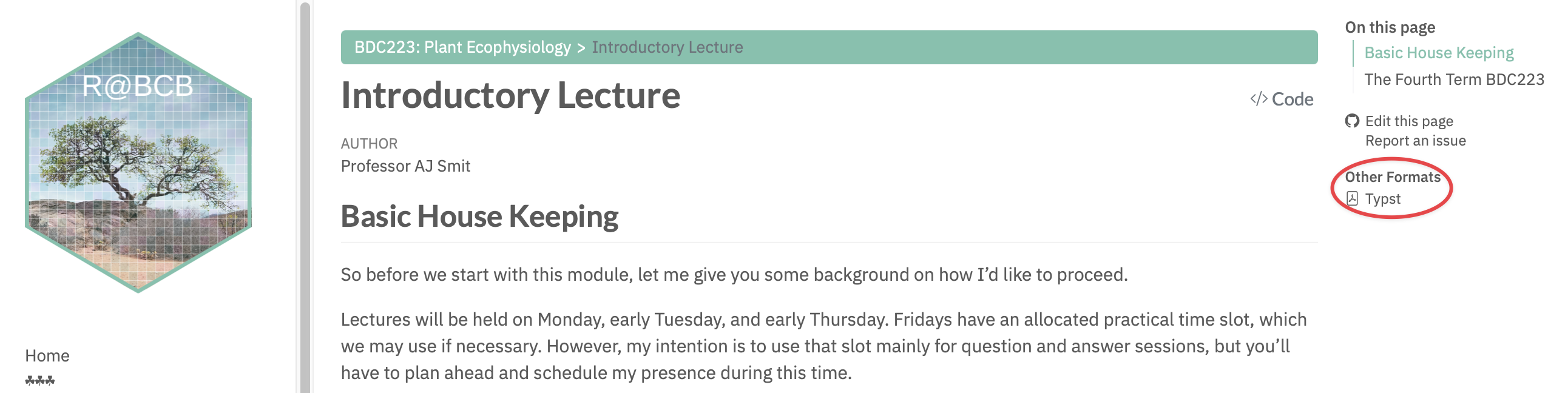
- You may downloaded the web material in the links on the left as PDF documents, which you may print out or use locally on your computers. Simply click on the “Typst” link, which appear on each lecture topic’s webpage, as shown below:
2 Consultation
If there’s something you don’t understand, please make an appointment (as a class) to see me on Friday after 2 pm. This will give you a chance to discuss any issues that came up during the week’s lectures. This set-up will allow us to revisit earlier material if there are any unresolved questions.
It’s largely in your hands how you want to use the Friday afternoon allocation. By default, I won’t interact unless you make an appointment, and when you do so, please make sure that you’re with a group of at least four or five people. I won’t hold individual meetings, since often questions are shared and it’s more efficient to address them together. That’s why the WhatsApp group exists. Use it to coordinate which topics are unclear, post your questions there, and I can respond either as a voice note or, if needed, we can use Friday afternoons for more detailed explanations.
I hope this format works for everyone. If not, let me know and we can look at alternatives. I’ll be available as much as possible on WhatsApp (less so during weekends), so please use that. I’ll definitely be available during the three lecture periods each week and, by appointment, on Friday afternoons.
3 The Fourth Term BDC223
In this fourth term, we’ll mostly be discussing plants – photosynthetic organisms, whether terrestrial or marine. Our focus will be the plant-related content equivalent to what Prof Maritz covered, but specifically on photosynthetic organisms.
Before we dive in, let’s have a basic overview of the module. I’ve already shared the slides; you can review them. At the beginning, I’ve included some quotes that I find amusing or thought-provoking; you’re welcome to read through those. If you’d like me to elaborate on any of them, let me know, but the goal is for them to inspire or provide some insight into the scientific mindset. For example, Richard Feynman, a physicist who died in the 1980s, believed that we’re all born knowing nothing, and lifelong learning gives life meaning. That’s also my view: there’s always more to learn, and science is about empowering you to answer questions that haven’t yet received enough thought.
There’s still plenty to discover in the world, and in this module, I’ll introduce you to knowledge that might be new to you regarding plant biology. There are many exciting developments out there; Prof Maritz has probably pointed out some, and I share that enthusiasm, especially since my research is in the ocean as a marine biologist. My perspective and approach will focus on ocean processes, while Prof Maritz’s emphasis is more on terrestrial ecosystems. Both perspectives are valuable and interconnected. Most of the processes we talk about are generalisable to other animal and plant/algal taxa.
4 Expectations
My main expectation is for you to read widely around the topics I make available. Some details will be in textbooks or other readings that I might not directly cover in lectures. Remember, exam questions won’t be limited to what I’ve said in class; your responsibility as science students is to explore and verify information on your own.
If you master all my lecture material as presented in the lecture slides (the figures, and lists of bullet-pointed factoids), it will probably get you about 70% in the exam; the rest comes from your broader reading and learning – such as that which you’ll find in the transcripts I have developed around the slides (i.e., the reading within which the slides are embedded, which you may access from the links to the lectures in the menu on the left). Teaching is about directing you, but learning is your personal process. Integrate the information, connect concepts, and aim for deep understanding. That’s not something I can give you. You create it for yourselves. To do that, read, interact with your peers, and engage with me (use WhatsApp for questions or alternative perspectives).
Science advances through scepticism and questioning, not authority. Always question, including me, your family, community leaders, and so on. Don’t accept things as fact simply because someone says so. Develop your own thinking and remain open-minded, sceptical, and inquisitive.
One of my slides talks about the difference between knowing and understanding. Listing names of snakes doesn’t mean you understand their behaviour. Go beyond memorisation to understanding why and how things happen. That’s the key to deep learning.
Having said this, I place a huge emphasis in my assessments on knowing the meanings of the words we will in the course. Know your definitions.
5 Class Attendance and Participation
All of my lecture material is made available upfront. Everything is already accessible, and you can find it in the links provided. However, please note that although I expect you to attend my lectures, there is very little I can do to compel you to be present.
There will be random quizzes during the week. Of course, you will not know when these will occur. If you miss one, the consequence is that you will lose marks that contribute towards your continuous assessment. In an ideal world, we as lecturers should not have to be concerned about whether or not you attend lectures. Many of my colleagues only release their lecture materials after they have actually presented in the class. They believe this practice encourages students to take notes in real time and creates an incentive to attend, as otherwise, students miss out on the discussions that may take place.
I take a somewhat different view. My opinion is that you are all adults. You have chosen to come to university, and you must decide how you wish to proceed with your studies. An engaged, proactive, and serious student would always attend classes. Such a student would always prepare for lectures in advance. It is in your own interest to act as if you are a serious student. In fact, it is in your interest to be a serious student.
Therefore, I am not going to be wielding sticks. I am not going to treat you like children. I am going to treat you as responsible adults. The way that I teach is very much the way I was taught when I was at university. I found this approach beneficial, and I hope that my way of teaching resonates with you.
In the end, I am here to guide you through the various lectures, but it is your own responsibility to learn. Teaching and learning are different in a very important way. Teaching is, essentially, the process of guiding you through all the content you are expected to know. Teaching also involves exploring some topics along the way, perhaps engaging with material or ideas that you may find interesting. Teaching cannot happen without an audience.
Learning, however, can take place only if you yourself engage with the material. Learning can happen without a teacher. There is a widespread misconception among students that, in order to know something, one must have been taught it. That idea is simply false. A committed student could stay at home, never attend a single lecture during the entire semester, and yet engage seriously and responsibly with all the available lecture material. That student could internalise the material, know it, understand it, integrate and synthesise it. That is what a serious student should be able to do. The entire process of learning can occur independently of being taught.
Indeed, everything I know now, today, as I am speaking to you, I have learnt post-PhD. I would venture to say that
6 My Research and Teaching Bias
As I said, I am a marine biologist. I work in the ocean, especially around South Africa (but also elsewhere), and my research is often ocean-centric. That doesn’t mean it’s irrelevant to land-based biology. I encourage you to draw general conclusions and connections across different contexts—integrate everything you learn.
7 Assessments
Tests and assessments will focus on integration and synthesis, rather than regurgitation. You’ll need to demonstrate that you can apply what you’ve learned to new problems.
7.1 Practical Work
There will be three (maybe four) practical labs dealing mainly with data analysis and calculations about plant ecophysiology: surface area/volume ratios, nutrient uptake, and light measurements. You’ll get lab assignments on Mondays, due the following Monday at midnight, with calculations to be shown in spreadsheets and conclusions in a MS Word document. I am also exploring the idea to intrioduce you to R coding (the very very basics) during one or two of the labs. No promises yet, but I’ll let you know.
7.2 Essay
You’ll also write a short personal essay, due roughly two weeks from now.
7.3 Mark Allocation
The mark allocation is the same (or very similar) to Prof Maritz’s section: random quizzes, two class tests (typically on the Thursdays or Fridays), and all work up to those points will be covered.
8 Lecture Content
Content for this module includes:
- Planetary boundaries (tomorrow’s topic) – about the limits to life.
- Climate change (starting Thursday) – its relevance to this module and biology as a whole.
- Plant stress – how plants experience and respond to stress.
- The role of light in the environment, critical to plant life.
- Heat stress and plant adaptation.
- Plant nutrition – their uptake of inorganic nitrogen and phosphorus, tying into global biogeochemical cycles and the carbon cycle.
9 Learning Outcomes
- Understand how environmental conditions (light, temperature, nutrients, etc.) affect plant distribution and interactions.
- Learn physiological mechanisms for water, nutrient, and carbon uptake in plants.
- Grasp the role of plants in the Earth system, integrating their function across contexts.
- Discuss ecophysiological processes involved in nutrient and water transport and loss.
- Examine the implications of global change and the limits of life on Earth.
Tomorrow we’ll focus on planetary boundaries, starting with people and their impact as the most destructive organism on the planet, then look at how plants adapt to environmental changes.
Good luck! Let’s get started.
Reuse
Citation
@online{smit,_a._j.,
  author = {Smit, A. J., and AJ Smit, Professor},
  title = {Introductory {Lecture}},
  url = {http://tangledbank.netlify.app/BDC223/L00-introduction.html},
  langid = {en}
}